 Add to Chrome
 Add to Firefox
 Add to Edge
Qwen-Image-Bench: From Generation to Creation in Text-to-Image Evaluation
May 27, 2026
Text-to-Image generation has evolved from basic image synthesis into a frequently used core capability in professional creative workflows, where simple text-image alignment can no longer satisfy users' pressing demands for faithful real-world reconstruction and genuine creative expression. Existing benchmarks, however, remain anchored in these foundational criteria and do not yet capture the nuanced capabilities that matter in authentic artistic practice, making it difficult to reliably distinguish state-of-the-art T2I models. To address the gap, we introduce Qwen-Image-Bench, a creator-centric benchmark co-designed with professional artists and grounded in real-world creation scenarios. Qwen-Image-Bench enriches conventional evaluation with two application-driven dimensions: Real-world Fidelity and Creative Generation. Drawing on the staged reasoning inherent in professional artistic workflows, we organize these five pillars into a top-down hierarchical taxonomy that further decomposes into 23 second-level sub-capabilities and 56 third-level verifiable rubrics. To ensure broad coverage, we curate 1000 stratified prompts with each prompt jointly exercising more than four fine-grained facets across multiple pillars. We train a unified judge model Q-Judger based on Qwen3.6-27B, supervised by 80 professional annotators from global art academies under blind labeling and triple-review protocols, that scores every image across all 56 verifiable facets, producing fine-grained, rubric-grounded, and fully attributable diagnostics rather than a single opaque score. Empirically, Qwen-Image-Bench reliably distinguishes leading T2I models, achieving the greatest separation on the two application-driven dimensions of Real-world Fidelity and Creative Generation where existing benchmarks provide little insight, while also providing a trustworthy optimization signal for production-level T2I development.

Qwen-Image-VAE-2.0 Technical Report
May 13, 2026We present Qwen-Image-VAE-2.0, a suite of high-compression Variational Autoencoders (VAEs) that achieve significant advances in both reconstruction fidelity and diffusability. To address the reconstruction bottlenecks of high compression, we adopt an improved architecture featuring Global Skip Connections (GSC) and expanded latent channels. Moreover, we scale training to billions of images and incorporate a synthetic rendering engine to improve performance in text-rich scenarios. To tackle the convergence challenges of high-dimensional latent space, we implement an enhanced semantic alignment strategy to make the latent space highly amenable to diffusion modeling. To optimize computational efficiency, we leverage an asymmetric and attention-free encoder-decoder backbone to minimize encoding overhead. We present a comprehensive evaluation of Qwen-Image-VAE-2.0 on public reconstruction benchmarks. To evaluate performance in text-rich scenarios, we propose OmniDoc-TokenBench, a new benchmark comprising a diverse collection of real-world documents coupled with specialized OCR-based evaluation metrics. Qwen-Image-VAE-2.0 achieves state-of-the-art reconstruction performance, demonstrating exceptional capabilities in both general domains and text-rich scenarios at high compression ratio. Furthermore, downstream DiT experiments reveal our models possess superior diffusability, significantly accelerating convergence compared to existing high-compression baselines. These establish Qwen-Image-VAE-2.0 as a leading model with high compression, superior reconstruction, and exceptional diffusability.
Qwen-Image-2.0 Technical Report
May 11, 2026We present Qwen-Image-2.0, an omni-capable image generation foundation model that unifies high-fidelity generation and precise image editing within a single framework. Despite recent progress, existing models still struggle with ultra-long text rendering, multilingual typography, high-resolution photorealism, robust instruction following, and efficient deployment, especially in text-rich and compositionally complex scenarios. Qwen-Image-2.0 addresses these challenges by coupling Qwen3-VL as the condition encoder with a Multimodal Diffusion Transformer for joint condition-target modeling, supported by large-scale data curation and a customized multi-stage training pipeline. This enables strong multimodal understanding while preserving flexible generation and editing capabilities. The model supports instructions of up to 1K tokens for generating text-rich content such as slides, posters, infographics, and comics, while significantly improving multilingual text fidelity and typography. It also enhances photorealistic generation with richer details, more realistic textures, and coherent lighting, and follows complex prompts more reliably across diverse styles. Extensive human evaluations show that Qwen-Image-2.0 substantially outperforms previous Qwen-Image models in both generation and editing, marking a step toward more general, reliable, and practical image generation foundation models.
Multi-modal Test-time Adaptation via Adaptive Probabilistic Gaussian Calibration
Apr 21, 2026Multi-modal test-time adaptation (TTA) enhances the resilience of benchmark multi-modal models against distribution shifts by leveraging the unlabeled target data during inference. Despite the documented success, the advancement of multi-modal TTA methodologies has been impeded by a persistent limitation, i.e., the lack of explicit modeling of category-conditional distributions, which is crucial for yielding accurate predictions and reliable decision boundaries. Canonical Gaussian discriminant analysis (GDA) provides a vanilla modeling of category-conditional distributions and achieves moderate advancement in uni-modal contexts. However, in multi-modal TTA scenario, the inherent modality distribution asymmetry undermines the effectiveness of modeling the category-conditional distribution via the canonical GDA. To this end, we introduce a tailored probabilistic Gaussian model for multi-modal TTA to explicitly model the category-conditional distributions, and further propose an adaptive contrastive asymmetry rectification technique to counteract the adverse effects arising from modality asymmetry, thereby deriving calibrated predictions and reliable decision boundaries. Extensive experiments across diverse benchmarks demonstrate that our method achieves state-of-the-art performance under a wide range of distribution shifts. The code is available at https://github.com/XuJinglinn/AdaPGC.
Test-Time Perturbation Learning with Delayed Feedback for Vision-Language-Action Models
Apr 20, 2026Vision-Language-Action models (VLAs) achieve remarkable performance in sequential decision-making but remain fragile to subtle environmental shifts, such as small changes in object pose. We attribute this brittleness to trajectory overfitting, where VLAs over-attend to the spurious correlation between actions and entities, then reproduce memorized action patterns. We propose Perturbation learning with Delayed Feedback (PDF), a verifier-free test-time adaptation framework that improves decision performance without fine-tuning the base model. PDF mitigates the spurious correlation through uncertainty-based data augmentation and action voting, while an adaptive scheduler allocates augmentation budgets to balance performance and efficiency. To further improve stability, PDF learns a lightweight perturbation module that retrospectively adjusts action logits guided by delayed feedback, correcting overconfidence issue. Experiments on LIBERO (+7.4\% success rate) and Atari (+10.3 human normalized score) demonstrate consistent gains of PDF in task success over vanilla VLA and VLA with test-time adaptation, establishing a practical path toward reliable test-time adaptation in multimodal decision-making agents. The code is available at \href{https://github.com/zhoujiahuan1991/CVPR2026-PDF}{https://github.com/zhoujiahuan1991/CVPR2026-PDF}.
* 12 pages, 7 figures, 5 tables
Orthogonal Uplift Learning with Permutation-Invariant Representations for Combinatorial Treatments
Feb 23, 2026We study uplift estimation for combinatorial treatments. Uplift measures the pure incremental causal effect of an intervention (e.g., sending a coupon or a marketing message) on user behavior, modeled as a conditional individual treatment effect. Many real-world interventions are combinatorial: a treatment is a policy that specifies context-dependent action distributions rather than a single atomic label. Although recent work considers structured treatments, most methods rely on categorical or opaque encodings, limiting robustness and generalization to rare or newly deployed policies. We propose an uplift estimation framework that aligns treatment representation with causal semantics. Each policy is represented by the mixture it induces over contextaction components and embedded via a permutation-invariant aggregation. This representation is integrated into an orthogonalized low-rank uplift model, extending Robinson-style decompositions to learned, vector-valued treatments. We show that the resulting estimator is expressive for policy-induced causal effects, orthogonally robust to nuisance estimation errors, and stable under small policy perturbations. Experiments on large-scale randomized platform data demonstrate improved uplift accuracy and stability in long-tailed policy regimes
FairJudge: An Adaptive, Debiased, and Consistent LLM-as-a-Judge
Feb 06, 2026Existing LLM-as-a-Judge systems suffer from three fundamental limitations: limited adaptivity to task- and domain-specific evaluation criteria, systematic biases driven by non-semantic cues such as position, length, format, and model provenance, and evaluation inconsistency that leads to contradictory judgments across different evaluation modes (e.g., pointwise versus pairwise). To address these issues, we propose FairJudge, an adaptive, debiased, and consistent LLM-as-a-Judge. Unlike prior approaches that treat the judge as a static evaluator, FairJudge models judging behavior itself as a learnable and regularized policy. From a data-centric perspective, we construct a high-information-density judging dataset that explicitly injects supervision signals aligned with evaluation behavior. Building on this dataset, we adopt a curriculum-style SFT-DPO-GRPO training paradigm that progressively aligns rubric adherence, bias mitigation, and cross-mode consistency, while avoiding catastrophic forgetting. Experimental results on multiple internal and public benchmarks show that FairJudge consistently improves agreement and F1, reduces non-semantic biases, and outperforms substantially larger instruction-tuned LLMs. All resources will be publicly released after acceptance to facilitate future research.
AgriAgent: Contract-Driven Planning and Capability-Aware Tool Orchestration in Real-World Agriculture
Jan 13, 2026Intelligent agent systems in real-world agricultural scenarios must handle diverse tasks under multimodal inputs, ranging from lightweight information understanding to complex multi-step execution. However, most existing approaches rely on a unified execution paradigm, which struggles to accommodate large variations in task complexity and incomplete tool availability commonly observed in agricultural environments. To address this challenge, we propose AgriAgent, a two-level agent framework for real-world agriculture. AgriAgent adopts a hierarchical execution strategy based on task complexity: simple tasks are handled through direct reasoning by modality-specific agents, while complex tasks trigger a contract-driven planning mechanism that formulates tasks as capability requirements and performs capability-aware tool orchestration and dynamic tool generation, enabling multi-step and verifiable execution with failure recovery. Experimental results show that AgriAgent achieves higher execution success rates and robustness on complex tasks compared to existing tool-centric agent baselines that rely on unified execution paradigms. All code, data will be released at after our work be accepted to promote reproducible research.
Qwen-Image-Layered: Towards Inherent Editability via Layer Decomposition
Dec 17, 2025Recent visual generative models often struggle with consistency during image editing due to the entangled nature of raster images, where all visual content is fused into a single canvas. In contrast, professional design tools employ layered representations, allowing isolated edits while preserving consistency. Motivated by this, we propose \textbf{Qwen-Image-Layered}, an end-to-end diffusion model that decomposes a single RGB image into multiple semantically disentangled RGBA layers, enabling \textbf{inherent editability}, where each RGBA layer can be independently manipulated without affecting other content. To support variable-length decomposition, we introduce three key components: (1) an RGBA-VAE to unify the latent representations of RGB and RGBA images; (2) a VLD-MMDiT (Variable Layers Decomposition MMDiT) architecture capable of decomposing a variable number of image layers; and (3) a Multi-stage Training strategy to adapt a pretrained image generation model into a multilayer image decomposer. Furthermore, to address the scarcity of high-quality multilayer training images, we build a pipeline to extract and annotate multilayer images from Photoshop documents (PSD). Experiments demonstrate that our method significantly surpasses existing approaches in decomposition quality and establishes a new paradigm for consistent image editing. Our code and models are released on \href{https://github.com/QwenLM/Qwen-Image-Layered}{https://github.com/QwenLM/Qwen-Image-Layered}
AgriGPT-Omni: A Unified Speech-Vision-Text Framework for Multilingual Agricultural Intelligence
Dec 11, 2025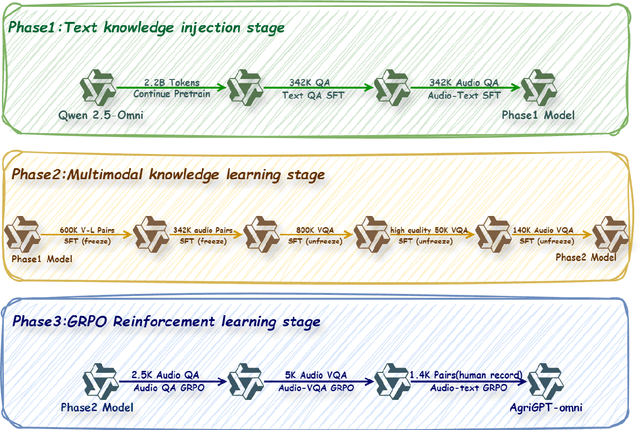
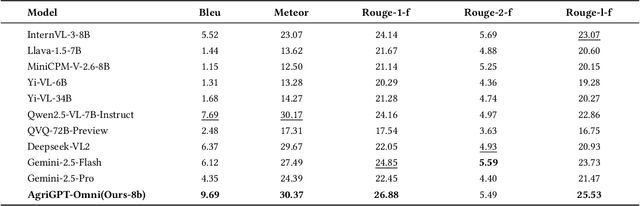
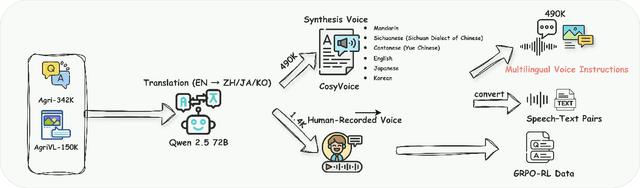
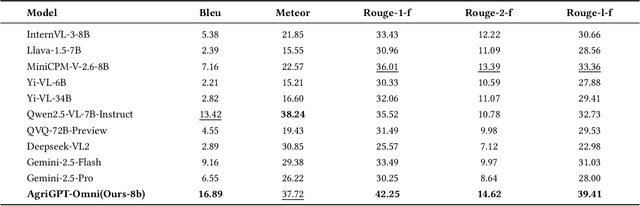
Despite rapid advances in multimodal large language models, agricultural applications remain constrained by the lack of multilingual speech data, unified multimodal architectures, and comprehensive evaluation benchmarks. To address these challenges, we present AgriGPT-Omni, an agricultural omni-framework that integrates speech, vision, and text in a unified framework. First, we construct a scalable data synthesis and collection pipeline that converts agricultural texts and images into training data, resulting in the largest agricultural speech dataset to date, including 492K synthetic and 1.4K real speech samples across six languages. Second, based on this, we train the first agricultural omni-model via a three-stage paradigm: textual knowledge injection, progressive multimodal alignment, and GRPO-based reinforcement learning, enabling unified reasoning across languages and modalities. Third, we propose AgriBench-Omni-2K, the first tri-modal benchmark for agriculture, covering diverse speech-vision-text tasks and multilingual slices, with standardized protocols and reproducible tools. Experiments show that AgriGPT-Omni significantly outperforms general-purpose baselines on multilingual and multimodal reasoning as well as real-world speech understanding. All models, data, benchmarks, and code will be released to promote reproducible research, inclusive agricultural intelligence, and sustainable AI development for low-resource regions.